

Fix a broken case in the doctor’s office
During an extraction, the maxillofacial surgeon broke off a piece of the all-ceramic tray that had recently been bonded to the patient’s tooth. The patient reasonably did not wish to have a new case made, so it was decided to repair it with a special material. The restoration was done immediately in one session at the doctor’s office. The patient is satisfied with the functional and aesthetic result of the correction.
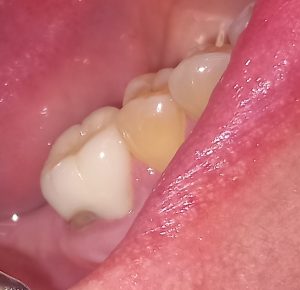
BEFORE
BEFORE
Preserving a baby tooth in an adult
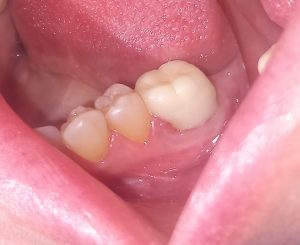
The patient visited the clinic because she had terrible pain on the right side of her lower jaw. After the clinical and x-ray examination, it was established the presence of a new tooth in her mouth. Unfortunately the baby tooth was broken in two. The treatment solution was the bisection of the young tooth and then its reconstruction with composite resin. During the bisection procedure, the patient was given local anesthesia and then the roots of the tooth were divided and that broken root was removed. The patient did not feel any pain. At the next appointment, the tooth was restored. This particular treatment was an emergency solution, as the patient did not want to have an implant placed in her mouth (which was the alternative treatment).
Certainly with the present conditions a point of contact with the adjacent tooth could not be attributed, as the distance was quite large.
The patient is happy that she avoided the implant procedure and within one session she was given a solution to her problem.
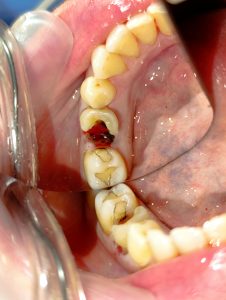
Original image before splitting the tooth
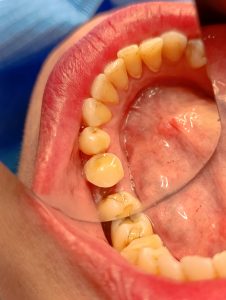
Final image after tooth reconstruction
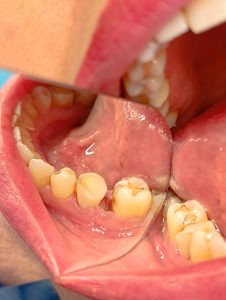
Final image after tooth reconstruction
Broken tooth
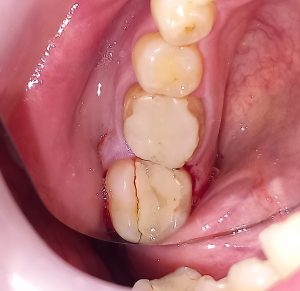
The patient broke his tooth during his meal. The tooth was denervated and unfortunately the patient was delaying the covering and protection of the tooth with a case / tooth crown. This resulted in the tooth breaking after some time and having to be extracted from the patient’s mouth. If the tooth had been protected with a case, the tooth could have been saved and the patient would not have lost his tooth.
Denervated teeth are prone to fracture and for this reason, it is important to protect them with a tooth holder so that they can be safely kept in the mouth. This is due
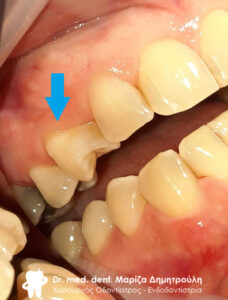
Bevel teeth
Many times a patient’s mouth shows teeth with a strange, rare position such as teeth with a curve, with an ectopic position, etc. These teeth should be examined in time by an orthodontist, so that it can be judged whether orthodontic treatment of the teeth is necessary in order to correct their position in the patient’s mouth. Teeth with irregularities in shape, size or position are likely to cause problems in the patient’s occlusion, so it is usually necessary to correct them in time because in the future the patient may suffer from musculoskeletal problems.
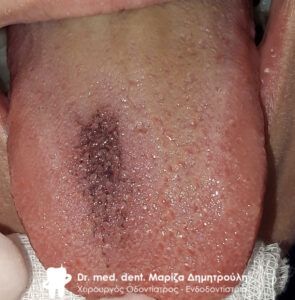
Black language
In some cases, it is possible for the patient’s tongue to be colored black. Certainly the patient is frightened and anxious. However, it is wise to contact the dentist or stomatologist immediately for a valid diagnosis and treatment. In the case below, the patient used chlorhexidine mouthwash for a certain period of time to treat a problem presented by her gums. She gradually noticed the pigmentation of her tongue, which became particularly pronounced after two weeks. Immediately after stopping chlorhexidine her tongue returned to its normal pink color.
Wisdom extraction with severe root bending
The patient came to the clinic for the extraction of the lower right wisdom tooth, which has been very painful for the last few days. The treatment solution was to extract the tooth, which was carried out on the same day after the administration of an appropriate amount of anesthetic. The next day the patient returned normally to his daily duties without swelling or pain. The extraction was carried out without any complications such as root fracture etc.
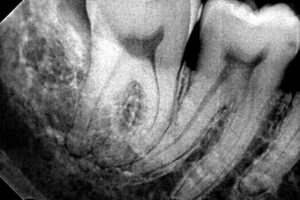
BEFORE
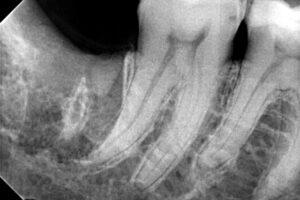
AFTER
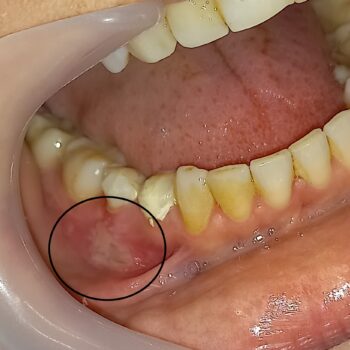
Mucosal irritation during denervation
In many cases it is possible that during denervation the mucous membrane of the adjacent area of the tooth being treated will be irritated. This irritation has the clinical picture shown in the photo below. This irritation is not at all alarming and occurs when the appropriate protective equipment, i.e. the isolator, is not used. After 1-2 weeks the mucous membrane calms down and returns to its original normal state.
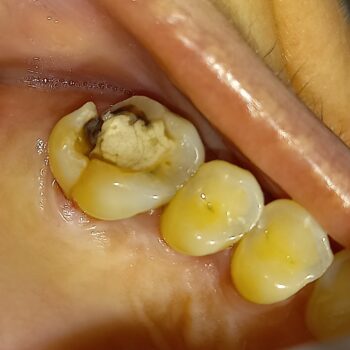
Fracture of denervated tooth
The patient had a tooth in which the denervation process had begun, but was delayed in completing in time. Endodontically treated teeth are sensitive and break much more easily compared to a living, non-denervated tooth. For this reason it is important that the denervation of a tooth ends in 2 – 3 appointments over a period of 2 weeks, as long as everything goes well and the tooth does not present any particular problem.
Widget After Content

Dr. med. dent. Mariza Dimitrouli
Dr. med. dent. Mariza Dimitrouli is a specialist at the University of Hannover, Germany (MHI) and also holds a PhD from the same university. She also worked in a dental clinic in Berlin. The title of Endodontist held by Dr. M. Dimitrouli is renewed every six years by the German Endodontics Society. She has a private practice in Thessaloniki, Thermi.